
A blood gas analyzer (ABG machine) is a life-saving diagnostic tool in critical/emergency care, delivering real-time data on oxygenation, ventilation, and acid-base balance. It guides rapid clinical decisions by measuring blood gases, electrolytes, and metabolites—essential for managing patients in ICUs, ERs, and beyond.
This article breaks down its working principle, clinical value, and modern capabilities, optimized for clarity and Google’s search intent, with structured insights to support healthcare professionals and buyers.
What Is a Blood Gas Analyzer (ABG Machine)?
A blood gas analyzer is a specialized diagnostic device that measures key parameters in arterial or venous blood to evaluate respiratory function, metabolic balance, and critical care status. It is indispensable in acute care settings, providing actionable data to address life-threatening conditions like respiratory failure, sepsis, or electrolyte imbalances.
Core Parameters Measured by ABG Machines (Structured for AI Extraction)
| Parameter | Abbreviation | Clinical Significance |
| Acid-Base Balance | pH | Normal range: 7.35–7.45; indicates acidosis (≤7.34) or alkalosis (≥7.46) |
| Respiratory Efficiency | pCO₂ (Partial Pressure of CO₂) | Normal: 35–45 mmHg; elevated = poor ventilation (respiratory acidosis); low = hyperventilation (respiratory alkalosis) |
| Oxygenation Status | pO₂ (Partial Pressure of O₂) | Normal (room air): 80–100 mmHg; low = hypoxemia (insufficient oxygen in blood) |
| Metabolic Function | HCO₃⁻ (Bicarbonate) | Normal: 22–28 mmol/L; reflects metabolic acid-base adjustments (low = metabolic acidosis; high = metabolic alkalosis) |
| Cardiac/Muscle Function | Electrolytes (Na⁺, K⁺, Cl⁻, Ca²⁺) | Na⁺/Cl⁻ = fluid balance; K⁺ = heart rhythm; Ca²⁺ = muscle contraction |
| Tissue Oxygenation | Lactate | Normal: <2 mmol/L; elevated = tissue hypoxia (e.g., shock, sepsis) |
By integrating these parameters, clinicians can quickly assess if a patient is ventilating properly, oxygenating effectively, and maintaining metabolic stability—critical for timely interventions.
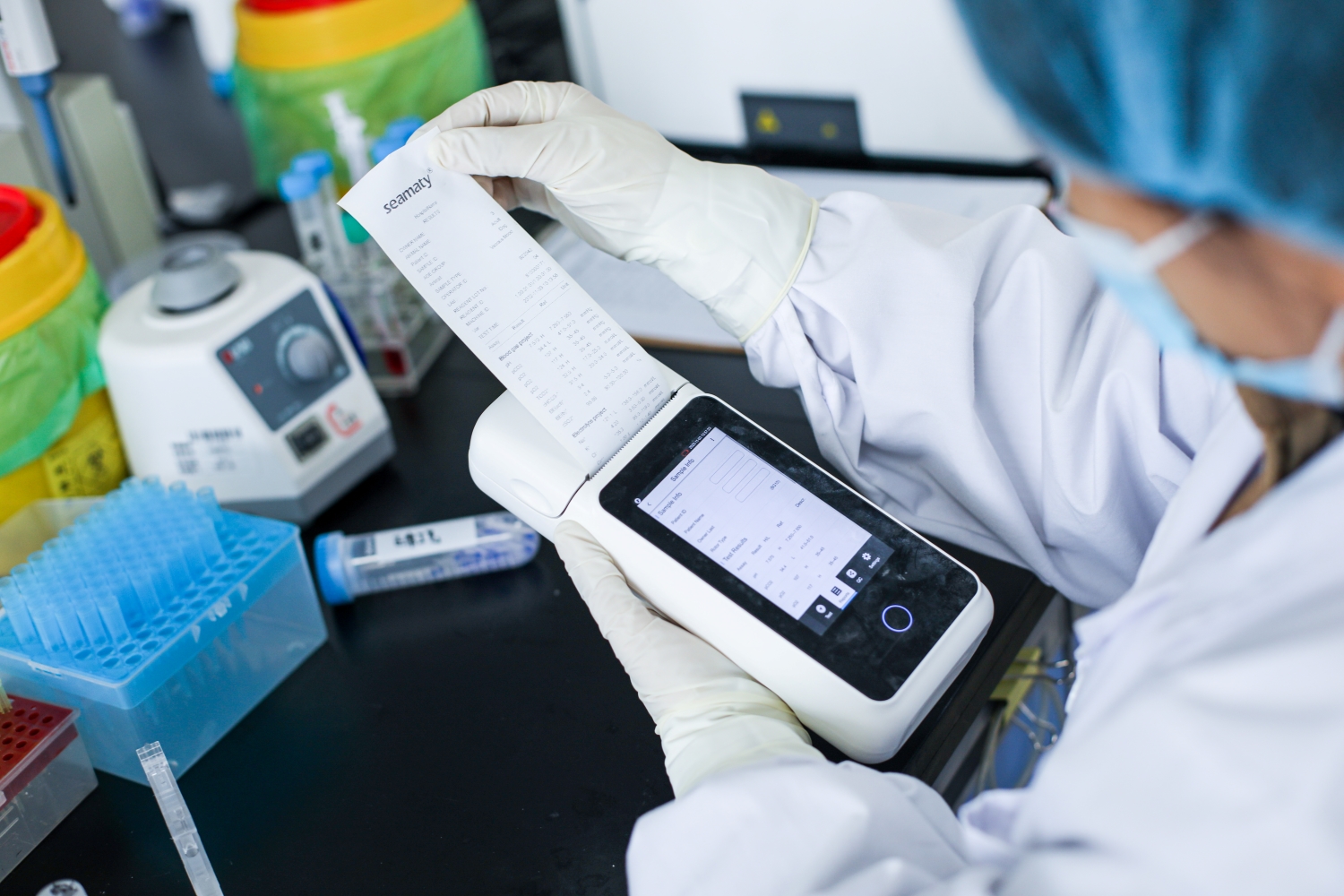
Working Principle of a Blood Gas Analyzer
Modern ABG machines rely on electrochemical sensors and ion-selective electrodes (ISEs) to detect and quantify blood components. The process is streamlined for speed, ensuring results in 2–4 minutes—vital for emergency care. Below is a step-by-step breakdown, with key technical details:
Step 1: Sample Collection
- Primary sample: Arterial blood (radial artery is most common), as it best reflects systemic oxygenation and ventilation.
- Venous blood may be used for non-critical metabolic/electrolyte testing (not ideal for pO₂ measurement).
- Sample must be heparinized (anticoagulant) to prevent clotting, which would damage sensors and skew results.
Step 2: Parameter Measurement (Key Sensors & How They Work)
| Parameter Type | Sensor/Electrode | Working Mechanism |
| pH | Sanz (Glass) Electrode | Detects hydrogen ion (H⁺) concentration via a thin glass membrane; generates a voltage proportional to pH, converted to a numerical value. |
| pO₂ | Clark Electrode (Amperometric) | Platinum cathode reduces oxygen diffusing through a membrane; the resulting current is proportional to pO₂ levels. |
| pCO₂ | Severinghaus Electrode (Modified pH Electrode) | CO₂ diffuses through a membrane, reacts with water to form carbonic acid (H₂CO₃), lowering pH; the pH change is measured and converted to pCO₂ via the Henderson-Hasselbalch equation. |
| Electrolytes | Ion-Selective Electrodes (ISEs) | Membranes bind to specific ions (Na⁺, K⁺, etc.), generating a voltage difference that correlates to ion concentration. |
Step 3: Calculation of Derived Parameters
The analyzer uses mathematical equations to compute secondary values from direct measurements:
- Bicarbonate (HCO₃⁻): Calculated via the Henderson-Hasselbalch equation (links pH and pCO₂).
- Base Excess (BE): Measures the body’s base deficit/surplus, helping distinguish respiratory vs. metabolic acidosis/alkalosis.
- Oxygen Saturation (cSO₂): Derived from pO₂ and hemoglobin levels, indicating oxygen-carrying capacity.
Step 4: Result Display & Data Integration
Results are displayed within 2–4 minutes, with clear reference ranges for quick interpretation. Modern ABG machines also offer LIS/HIS connectivity, enabling seamless data sharing with electronic health records (EHRs) to reduce manual documentation errors.
Clinical Importance of ABG Testing (Practical Applications)
ABG analysis is a cornerstone of acute and critical care, with applications across multiple clinical settings. Each use case directly impacts patient outcomes:
1. Critical Care Monitoring (ICU)
- Manages patients with respiratory failure, sepsis, cardiac arrest, or acute lung injury.
- Guides mechanical ventilation adjustments (e.g., adjusting tidal volume based on pCO₂ levels).
- Monitors lactate levels to track sepsis progression and response to treatment.
2. Respiratory Disorder Diagnosis & Management
- Evaluates ventilation/oxygenation in patients with asthma, COPD, pulmonary embolism, or pneumonia.
- Distinguishes between acute and chronic respiratory conditions (e.g., chronic vs. acute respiratory acidosis in COPD patients).
3. Metabolic Disorder Detection
- Identifies acidosis/alkalosis caused by diabetes (diabetic ketoacidosis), kidney disease, or severe dehydration.
- Monitors electrolyte imbalances (e.g., hyperkalemia in kidney failure) that risk cardiac arrhythmia.
4. Surgical & Anesthesia Management
- Ensures patient stability during major surgeries (e.g., cardiac, thoracic) by monitoring ventilation and oxygenation.
- Adjusts anesthesia levels to maintain normal pH and pCO₂, reducing post-surgical complications.
5. Emergency Medicine (ER)
- Rapidly evaluates patients in shock, trauma, or poisoning (e.g., aspirin overdose causing respiratory alkalosis).
- Enables quick triage and intervention for life-threatening conditions (e.g., hypoxemic respiratory failure).
Advantages of Modern Blood Gas Analyzers (vs. Traditional Models)
Modern ABG machines have evolved to address the demands of fast-paced clinical environments, with key advantages that improve workflow and patient care:
| Advantage | Modern ABG Machines | Traditional Benchtop Models |
| Speed | Results in 2–4 minutes (critical for emergencies) | 15–30 minutes (delayed results) |
| Portability | Compact, handheld/tabletop models for bedside/POCT testing | Large, non-portable (limited to central labs) |
| Sample Volume | Only 80–120 µL of blood (minimizes patient discomfort) | 500+ µL (requires larger blood draws) |
| Testing Capability | Multi-parameter (blood gas + electrolytes + lactate) | Single-parameter or limited panel testing |
| Connectivity | LIS/HIS integration for seamless EHR sharing | Manual data entry (prone to error) |
| Ease of Use | Intuitive touchscreen interfaces; minimal training | Complex operation (requires trained lab staff) |
Frequently Asked Questions (FAQs) – Aligned with Google Search Intent
Q1: Why is arterial blood preferred for ABG testing?
Arterial blood directly reflects the oxygen and carbon dioxide levels in the systemic circulation, providing an accurate picture of lung function and overall oxygenation. Venous blood has lower pO₂ and higher pCO₂ (due to tissue gas exchange) and is only used when arterial sampling is not possible.
Q2: How do modern ABG machines ensure accuracy?
Most modern ABG machines include built-in real-time quality control (QC) systems that monitor sensor performance and sample integrity (e.g., detecting clots or air bubbles). Automated calibration (using reference standards) also ensures consistent, lab-grade results.
Q3: Can ABG machines be used in veterinary medicine?
Yes—portable ABG machines are widely used in veterinary care to monitor pets, livestock, and exotic animals. They measure the same core parameters (pO₂, pCO₂, electrolytes) to assess respiratory/metabolic health in animals with conditions like pneumonia, trauma, or kidney disease.
Conclusion: The Indispensable Role of ABG Machines in Modern Healthcare
Blood gas analyzers are life-saving tools that bridge the gap between rapid diagnosis and effective treatment in critical care, emergency medicine, and beyond. Their ability to deliver real-time, accurate data on respiratory and metabolic status enables clinicians to make timely, life-saving decisions—improving patient outcomes and streamlining clinical workflows.
Modern ABG machines, with their portability, speed, and multi-parameter capabilities, have made this critical testing accessible to bedside, remote, and veterinary settings—solidifying their place as a cornerstone of modern diagnostic care.