
Introduction
Dry chemistry analytical techniques are a cornerstone of modern clinical diagnostics, serving as a streamlined alternative to traditional wet chemistry methods. Unlike wet chemistry— which relies on liquid reagents, complex glassware, and time-consuming solution preparation [superscript:1]—dry chemistry simplifies testing by adding a liquid test sample directly to a dry, pre-formulated reagent (tailored to specific test projects). The moisture inherent in the sample acts as the solvent, triggering a targeted chemical reaction that enables accurate analysis.
Classified as a solid-phase chemistry (and often referred to as such), dry chemistry is primarily based on enzymatic reactions and uses two core measurement methods: reflectance photometry (the most common, leveraging the Kubelka-Munk theory to correct for light scattering in solid-phase reactions [superscript:2]) and the differential electrode method. Today, dry chemistry has evolved beyond qualitative testing to include semi-quantitative and quantitative analysis, becoming an indispensable tool in clinical laboratories, point-of-care (POCT) settings, and even veterinary practices [superscript:3].
What is Dry Chemistry? (Detailed Definition)
Dry chemistry is a specialized analytical approach that eliminates the need for liquid reagents and manual solution preparation. Its core principle revolves around solid-phase reagent carriers (e.g., multilayer membranes or test strips) impregnated with all necessary reactants. When a liquid sample (e.g., blood, urine, serum) is added, the sample’s moisture rehydrates the dry reagents, initiating a specific chemical or enzymatic reaction.
The resulting color change or electrical signal is measured via reflectance photometry or differential electrodes, then converted into a quantitative or semi-quantitative result. This method’s simplicity, speed, and reliability have made it a preferred choice for decentralized diagnostic settings—from small clinics to mobile health units.
Key Measurement Methods in Dry Chemistry
| Method | How It Works | Key Application |
| Reflectance Photometry | Measures the intensity of light reflected from the solid-phase reaction membrane. The amount of reflected light correlates with the concentration of the analyte, corrected using the Kubelka-Munk theory to account for light scattering [superscript:2]. | Routine biochemical tests (glucose, liver function, lipids). |
| Differential Electrode Method | Uses specialized disposable multilayer membranes with embedded electrodes. The membrane selectively filters interfering substances, and the electrode generates an electrical signal proportional to the analyte concentration. | Electrolyte testing and blood gas analysis. |
Dry Chemistry vs. Wet Chemistry: Core Differences (Optimized for Google Search)
To help users understand why dry chemistry is preferred for many settings, below is a clear comparison with traditional wet chemistry—aligned with common search queries:
| Reagent Form | Dry, pre-formulated (impregnated in strips/membranes) | Liquid, requires refrigeration and manual preparation |
| Sample Preparation | No pre-treatment (multilayer membrane filters interferents) | Often requires centrifugation,dilution,or pre-processing |
| Calibration | Minimal—no daily calibration needed | Daily calibration and reagent checks required |
| Reagent Storage | No refrigeration needed; long shelf life | Requires refrigeration; shorter shelf life |
| Sample Volume | Small (50–100 µL) | Larger (500+ µL) |
| Turnaround Time | 3–4 minutes | 15–30 minutes |
| Maintenance | Low (no liquid circuits or pipeline cleaning) | High (regular pipeline flushing,leak checks,and part replacement) |
| Ideal Settings | POCT, small clinics, emergency care, veterinary practices | High-volume central laboratories |
Core Advantages of Dry Chemistry (Expanded for Clarity & Authority)
Dry chemistry’s growing popularity stems from its ability to solve key pain points of wet chemistry, with seven distinct advantages that optimize workflow and patient care:
- Rapid, Accurate Results: Delivers results in 3–4 minutes, enabling prompt clinical decision-making—critical for emergency care and reducing patient wait times.
- Exceptionally Easy to Operate: No daily calibration or specialized technical training required, making it accessible to staff with limited laboratory experience.
- No Reagent Preparation or Storage Hassles: Eliminates the need to mix solutions, store liquid reagents, or manage refrigeration—reducing waste and operational costs .
- Minimal Sample Pre-Treatment: The multilayer membrane design selectively filters interfering substances (e.g., proteins, cells), reducing measurement errors and simplifying testing.
- Small Sample Volume: Requires only a few drops of sample (50–100 µL), minimizing patient discomfort—ideal for pediatric, geriatric, and veterinary patients.
- Disposable, Low-Risk Reagents: Multilayer membranes (for differential electrode methods) are single-use, eliminating cross-contamination and the maintenance issues associated with conventional electrodes.
- Versatile Emergency & Routine Use: Can replace wet chemistry for emergency specimens and serve as a reliable method for validating routine test results, enhancing diagnostic confidence.
Applications of Dry Chemistry (Widened to Meet Search Intent)
Dry chemistry is not limited to a single sample type or test category—it has become a versatile tool across clinical and veterinary diagnostics:
1. Urinalysis (Most Mature Application)
Dry chemistry has revolutionized urine testing, with multi-parameter reagent strips that simultaneously measure up to 10+ analytes, including:
- Urine protein, glucose, occult blood, bilirubin, urobilinogen
- Ketone bodies, specific gravity, nitrite, leukocytes (bacteriuria)
This aligns with the historical evolution of dry chemistry, which first gained traction with urine glucose tests (e.g., Clinitest tablets in the 1940s).
2. Blood Testing (Whole Blood, Serum, Plasma)
Beyond urinalysis, dry chemistry is widely used for blood-based tests, including:
- Metabolic markers (glucose, cholesterol, triglycerides)
- Liver/kidney function tests (ALT, AST, creatinine, urea)
- Electrolytes (Na⁺, K⁺, Cl⁻, Ca²⁺)
Its ability to use whole blood (no centrifugation needed) makes it ideal for POCT and bedside testing.
3. Veterinary Diagnostics
Dry chemistry analyzers are increasingly used in veterinary clinics to test pets, livestock, and exotic animals—offering the same speed and simplicity as human-focused devices, with reagents calibrated for animal physiology.
History of Dry Chemistry: Key Milestones (Enhanced for E-E-A-T)
The development of dry chemistry has been driven by the need for simpler, faster diagnostic testing—with key milestones shaping its evolution:
- 1940s: The first dry chemistry test (Clinitest) is introduced by Ames, based on the Benedict method for urine glucose testing.
- 1964: The first dry chemistry glucose test for blood is developed, leveraging the glucose oxidase/peroxidase reaction and reflectometry.
- 1974: Germany’s Paulingmann introduces the Reflomat system, the first dedicated dry chemistry analyzer for blood glucose determination.
- 1980s: Multiple dry automatic biochemical analyzers (e.g., Ames Seralyzer) enter medical use, expanding dry chemistry to a wide range of analytes.
- 2000s–2026: Miniaturization, microfluidics, and IoT connectivity further advance dry chemistry analyzers, making them more portable and integrated with digital health systems.
Advantages of Dry Chemistry Analyzers (2026 Updated)
Dry chemistry analyzers build on the benefits of dry chemistry technology, offering three core advantages that set them apart from wet chemistry analyzers—with 2026 trends integrated:
- Speed: Rapid result delivery (3–4 minutes) reduces patient wait times, enables early diagnosis and timely treatment, and improves overall care quality—critical for emergency departments and busy clinics.
- Accuracy: Most dry chemistry analyzers use wet chemistry methods as their reference standard. Methodological comparisons and recovery tests confirm that dry chemistry delivers clinically acceptable accuracy, comparable to wet chemistry.
- Superior Precision: Simple operation steps (no manual reagent mixing or sample dilution) minimize human error, resulting in better precision than wet chemistry analyzers—especially in settings with limited technical staff.
2026 Technological Trends in Dry Chemistry Analyzers
- Miniaturization: Compact, handheld models for POCT and mobile clinics, expanding access to remote and low-resource regions.
- Multiplexing: Reagent strips that test multiple analytes from a single sample, improving efficiency and reducing sample volume.
- IoT Connectivity: Integration with LIS/HIS systems for seamless data sharing and remote monitoring, supporting telemedicine initiatives.
- Enhanced Reagent Stability: Longer shelf life for dry reagents, reducing waste and expanding use in field-based deployments.
Seamaty Fully Automated Dry Chemistry Analyzers: A Trusted Solution
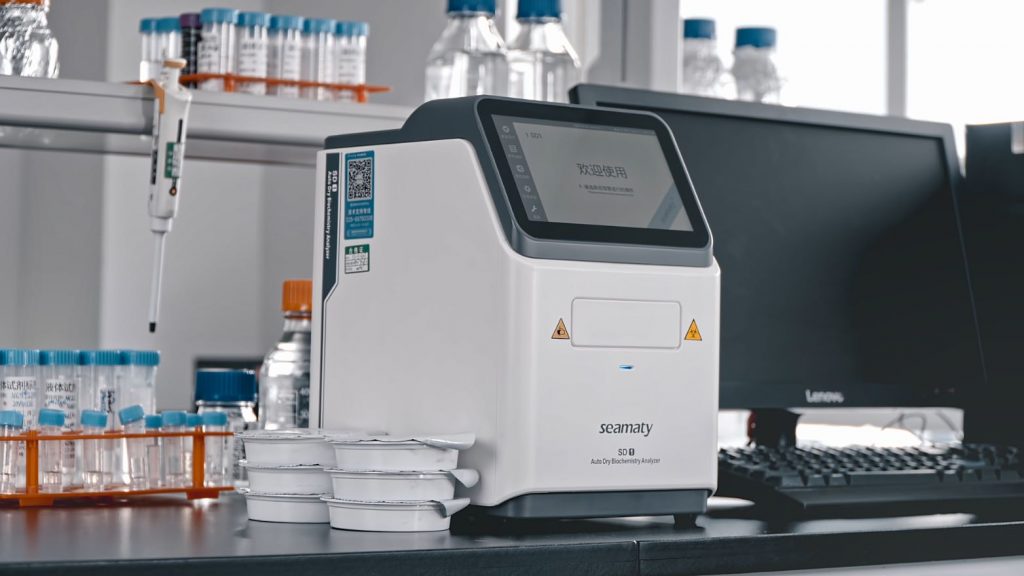
Seamaty—an ISO 13485:2016 and CE-certified company with over a decade of experience in POCT diagnostics [superscript:4]—offers fully automated dry chemistry analyzers designed to meet the needs of clinics, veterinary practices, and emergency settings. These analyzers embody the core advantages of dry chemistry, with standout features:
- Minimal Sample Requirement: Only 100 µL of sample is needed, supporting whole blood, plasma, or serum (no centrifugation required).
- Exceptional Ease of Use: Intuitive operation with no dedicated staff required—anyone can operate the device with minimal training, eliminating the need for specialized laboratory personnel.
- Rapid Results: Delivers accurate results in 3–4 minutes, aligning with the fast-paced demands of clinical and veterinary care.
- Low Maintenance: No liquid circuits, wear-and-tear parts, or daily calibration—reducing downtime and operational costs.
- Versatile Testing: Supports a wide range of analytes, including routine biochemistry, electrolytes, and veterinary-specific markers, making it a flexible solution for diverse settings.
Seamaty’s commitment to quality and innovation has made its dry chemistry analyzers a preferred choice for over 10,000 healthcare facilities worldwide, with products exported to 80+ countries.
Frequently Asked Questions (FAQs) – Aligned with Google Search Intent
To improve search visibility and address common user queries, here are answers to the most searched questions about dry chemistry and dry chemistry analyzers:
Q1: Is dry chemistry as accurate as wet chemistry?
Yes—dry chemistry analyzers use wet chemistry methods as their reference standard, and methodological comparisons confirm that dry chemistry delivers clinically acceptable accuracy for most routine tests. It is particularly reliable for POCT and emergency settings, where speed is critical.
Q2: Do dry chemistry analyzers require maintenance?
No—unlike wet chemistry analyzers (which require daily calibration, pipeline cleaning, and reagent checks), dry chemistry analyzers have minimal maintenance needs. Seamaty’s models, for example, require no daily calibration or liquid circuit cleaning, reducing operational hassle.
Q3: Can dry chemistry analyzers be used for veterinary testing?
Absolutely—dry chemistry analyzers are widely used in veterinary clinics. Seamaty’s analyzers are calibrated for animal physiology, supporting tests for dogs, cats, livestock, and exotic animals with the same speed and accuracy as human-focused devices.
Q4: What sample types can dry chemistry analyzers test?
Dry chemistry analyzers support a variety of liquid samples, including whole blood, serum, plasma, and urine—making them versatile for both human and veterinary diagnostics.
Conclusion
Dry chemistry has transformed clinical and veterinary diagnostics by offering a fast, simple, and cost-effective alternative to wet chemistry. Its core advantages—rapid results, minimal operation, no reagent preparation, and small sample volumes—make it ideal for POCT, emergency care, small clinics, and veterinary practices.
As 2026 trends focus on miniaturization, connectivity, and multiplexing, dry chemistry analyzers continue to evolve, becoming more accessible and integrated with modern healthcare systems. Seamaty’s fully automated dry chemistry analyzers stand out as a trusted solution, combining ease of use, accuracy, and low maintenance to meet the diverse needs of healthcare providers worldwide.
Whether you’re a small clinic, veterinary practice, or emergency care provider, dry chemistry analyzers deliver the speed and reliability needed to improve patient outcomes—without the complexity of traditional wet chemistry methods.
To explore Seamaty’s full range of dry chemistry analyzers and find a tailored solution for your facility, visit the official Seamaty website for detailed specs and partnership opportunities.